How Big Should My Dutch Oven Be For Sourdough Baking
Choosing the right Dutch oven size for your sourdough baking is one of the most important decisions you will make. A Dutch oven that is too small will restrict oven spring, while one that is too large can dry out your loaf. This guide walks you through the best Dutch oven sizes for every batch size, helping you bake sourdough bread with a perfect bread crust every single time.
There is nothing quite like pulling a golden, crusty sourdough loaf out of a Dutch oven. The sound of that crackling bread crust, the smell of sourdough flour and wild yeast — it is pure magic. But here is the thing that many home bakers overlook. The size of your Dutch oven matters a lot. If you use the wrong one, your sourdough bread will not rise properly, the bread crust will be uneven, and the crumb will disappoint. This guide will show you exactly how to pick the right Dutch oven for your sourdough baking. Whether you are just starting out with your first sourdough starter or you have been baking for years, you will find clear, practical advice here.
When I first started baking sourdough, I used whatever pot I had in my kitchen. It was too small, and my loaves spread out instead of rising up tall. After some trial and error, I learned that Dutch oven size is not just a detail — it is the foundation of great bread baking. In this article, I will break down everything you need to know about choosing the perfect Dutch oven for your sourdough recipe. We will look at quart sizes, dough weights, shape options, and common mistakes. By the end, you will know exactly what to buy and why.
Key Takeaways
- 5-quart Dutch ovens are the sweet spot for most home bakers making standard sourdough loaves.
- Dutch oven capacity should match your dough weight to allow proper oven spring and bread crust formation.
- Cast iron Dutch ovens retain heat best, but ceramic and enameled options work well too.
- Buying a Dutch oven that is too small or too large is a common mistake that ruins sourdough bread baking results.
- Shape matters — round Dutch ovens suit most sourdough recipes, while oval ones work for longer loaves.
- Preheating your Dutch oven for at least 30 minutes is essential for great sourdough baking.
- The right Dutch oven size gives you consistent, bakery-quality sourdough loaves at home.
📑 Table of Contents
- Why Dutch Oven Size Matters for Sourdough
- Understanding Dutch Oven Capacity and Sourdough Loaf Size
- Best Dutch Oven Sizes for Different Sourdough Batches
- How to Choose the Right Dutch Oven for Your Sourdough
- Common Mistakes When Choosing a Dutch Oven for Sourdough
- Expert Tips for Perfect Sourdough Baking in a Dutch Oven
- Key Takeaways
- Conclusion
Why Dutch Oven Size Matters for Sourdough
The size of your Dutch oven directly affects how your sourdough bread bakes. A Dutch oven works by trapping steam from your dough. This steam keeps the outer surface of the loaf moist during the early stages of bread baking. That moisture is what allows the bread crust to expand freely while the inside rises. This process is called oven spring. Without proper oven spring, your sourdough loaf will be flat and dense.
The Science Behind Dutch Oven Baking
When you place shaped dough into a preheated Dutch oven, the trapped heat and steam create the perfect baking environment. The Dutch oven lid holds moisture inside, which turns into steam. This steam keeps the dough surface flexible so it can expand. As the bread baking continues, the steam escapes through the lid vent or small gaps. The Dutch oven then acts like a small oven within your oven, concentrating heat around the loaf.
This is why Dutch oven capacity is so important. If the pot is too full, steam cannot circulate properly. If it is too empty, too much steam escapes, and the dough dries out before it can rise. The right Dutch oven size creates a balanced environment where sourdough shaping and bread baking work together beautifully.
How Oven Spring Relies on Proper Size
Oven spring is the rapid rise that happens in the first 10 to 15 minutes of sourdough bread baking. This is when your sourdough loaf grows from its shaped form to its final height. A Dutch oven that is too small will squeeze the dough and limit this rise. You will end up with a squat, wide loaf instead of a tall, beautiful boule.
On the other hand, a Dutch oven that is too large lets too much steam escape. The dough surface dries out too quickly, forming a thick bread crust before the inside has finished rising. The result is a loaf with a tough exterior and a gummy interior. Finding the right Dutch oven size for your dough is the single biggest factor in achieving great oven spring.
Understanding Dutch Oven Capacity and Sourdough Loaf Size
Not all sourdough loaves are the same size. A single personal loaf needs a very different Dutch oven than a large boule meant to feed a family. Understanding how Dutch oven capacity relates to sourdough loaf size will help you make the right choice every time.
Quart Sizes Explained
Dutch ovens come in several standard sizes. Here is a quick breakdown of the most common options and what they are best for:
- 3-quart Dutch oven: Best for small personal loaves or test batches. Holds about 1 to 1.5 pounds of dough.
- 5-quart Dutch oven: The most popular size for sourdough baking. Fits a standard 1 to 1.5 pound loaf perfectly.
- 6-quart Dutch oven: Great for larger loaves or baking two smaller loaves at once.
- 7-quart Dutch oven: Ideal for big batches, baking multiple loaves, or oversized sourdough boules.
- 9-quart Dutch oven: Best for serious home bakers who bake frequently or for gatherings.
Matching Loaf Size to Dutch Oven Capacity
A good rule of thumb is to fill your Dutch oven no more than two-thirds full with dough. This gives your sourdough loaf room to rise and expand during bread baking. Here is a simple guide to help you match dough weight to Dutch oven size:
- 400 to 500 grams of dough: A 3-quart or 5-quart Dutch oven works well.
- 500 to 750 grams of dough: A 5-quart Dutch oven is the ideal choice.
- 750 to 1000 grams of dough: A 6-quart or 7-quart Dutch oven gives enough space.
- Over 1000 grams of dough: Go with a 7-quart or 9-quart Dutch oven.
When in doubt, go one size up rather than one size down. A little extra space is always better than too little. Your sourdough starter will thank you with a beautiful rise.
Best Dutch Oven Sizes for Different Sourdough Batches
Every baker has different needs. Some bake for one, others for a whole family. Some prefer small individual loaves, and some love big rustic boules. Let us look at the best Dutch oven sizes for different sourdough baking scenarios.
Small Batches and Personal Loaves
If you are baking for one or two people, a smaller Dutch oven is perfect. A 3-quart or 4-quart Dutch oven works great for personal-sized sourdough loaves. These smaller pots concentrate heat well, which means you get excellent bread crust formation even with less dough. The downside is that you cannot make large loaves in them. But for a single serving of fresh sourdough bread, they are hard to beat.
Medium Batches for Everyday Baking
The 5-quart Dutch oven is the gold standard for sourdough baking. Most sourdough recipes call for about 500 grams of flour, which produces a loaf that fits perfectly in a 5-quart pot. This size gives you enough room for great oven spring while keeping the steam trapped inside. If you are unsure which Dutch oven to buy, go with a 5-quart. It is the most versatile option and will serve you well for everyday bread baking.
Large Batches for Sharing
When you are baking for a crowd or want to make oversized sourdough boules, a 6-quart, 7-quart, or even 9-quart Dutch oven is the way to go. These larger pots can handle big dough batches and still provide the steam environment needed for a great bread crust. Many experienced bakers use a 7-quart Dutch oven for their weekly sourdough bread baking routine. It gives plenty of room without wasting energy.
| Dutch Oven Size | Best For | Dough Weight | Loaf Shape |
|---|---|---|---|
| 3-Quart | Personal loaves, test bakes | 400-500g | Small boule or batard |
| 5-Quart | Standard home baking | 500-750g | Full-size boule or batard |
| 6-Quart | Larger loaves or two small ones | 750-1000g | Large boule or two small loaves |
| 7-Quart | Big batches, family-sized loaves | 1000g+ | Oversized boule or multiple loaves |
| 9-Quart | Serious bakers, gatherings | 1200g+ | Multiple large loaves |
How to Choose the Right Dutch Oven for Your Sourdough
Choosing a Dutch oven for sourdough baking is about more than just picking a size. There are other factors that affect how your sourdough bread turns out. Let us walk through the key considerations.
Material Considerations
The material of your Dutch oven affects heat retention, heat distribution, and durability. Here are the most common options:
- Cast iron Dutch oven: This is the classic choice for sourdough baking. Cast iron retains heat incredibly well, which means steady, even bread baking. It is heavy, but that weight is what makes it work so well. Lodge is a popular brand that makes excellent cast iron Dutch ovens for sourdough bread baking.
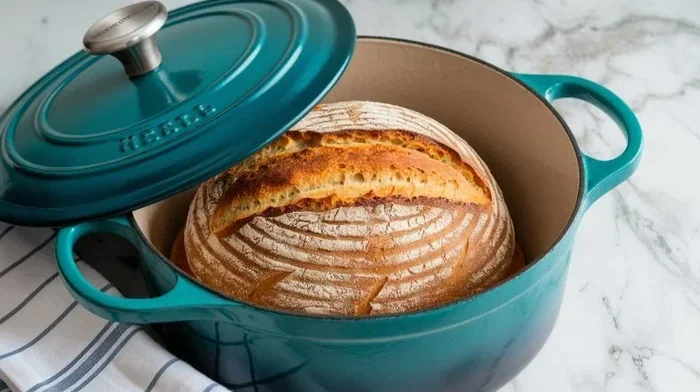
- Enameled cast iron: This is the same cast iron core with a glass-like enamel coating. It is easier to clean and does not require seasoning. Brands like Le Creuset and Staub make beautiful enameled Dutch ovens that work wonderfully for sourdough baking.
- Ceramic Dutch oven: Ceramic options are lighter and heat up quickly. They work well for sourdough baking, but they may not retain heat as long as cast iron. They are a good choice if you want something lighter and easier to handle.
- Stainless steel: These are less common for sourdough baking because they do not retain heat as well. However, some high-end stainless steel Dutch ovens with thick bases can work for bread baking.
Shape Matters: Round vs. Oval
The shape of your Dutch oven affects how your sourdough loaf fits and bakes. Most sourdough recipes call for a round Dutch oven, which is perfect for shaping boules. A round pot allows the dough to expand evenly in all directions, promoting uniform oven spring and an even bread crust.
Oval Dutch ovens work best for longer, oval-shaped loaves like batards. If you prefer shaping sourdough into elongated forms, an oval Dutch oven gives you the space to do so. For most beginners, a round 5-quart Dutch oven is the safest and most versatile choice.
Quick Tips for Choosing Your Dutch Oven
- Always check the Dutch oven capacity before buying. Look for the quart size on the label.
- Make sure the Dutch oven lid fits snugly to trap steam during sourdough bread baking.
- Choose a Dutch oven with handles that are oven-safe to at least 450 degrees Fahrenheit.
- If you are new to sourdough baking, start with a 5-quart round Dutch oven.
- Consider how heavy the Dutch oven is. You will be lifting a hot pot, so comfort matters.
- Read reviews from other sourdough bakers to see how a specific Dutch oven performs in real bread baking situations.
Common Mistakes When Choosing a Dutch Oven for Sourdough
Even experienced bakers sometimes make mistakes when selecting a Dutch oven for sourdough baking. Here are the most common errors and how to avoid them.
Buying Too Small
This is the number one mistake. A Dutch oven that is too small will crowd your sourdough loaf, preventing proper oven spring. The dough will spread out instead of rising up, and the bread crust will be thick and hard. Before buying, check the capacity of the Dutch oven against the weight of your sourdough dough. Always leave room for the loaf to grow.
Buying Too Large
While too small is the bigger problem, too large can also cause issues. A Dutch oven that is too big will not hold enough steam around the dough. The bread crust will form too early, and the sourdough loaf will not rise as much as it should. If you only bake small loaves, there is no need to buy a 9-quart Dutch oven. Match the size to your typical batch.
Ignoring the Lid Fit
The Dutch oven lid plays a crucial role in sourdough baking. If the lid does not fit tightly, steam will escape, and you will lose the moisture your dough needs. Some Dutch ovens have loose-fitting lids or gaps that let steam out. Always check how well the lid seals before purchasing a Dutch oven for sourdough bread baking.
Skipping the Preheating Step
Even with the right Dutch oven size, skipping preheating can ruin your sourdough bread. The Dutch oven must be hot when the dough goes in. This is what creates the initial burst of oven spring. Many beginners skip this step and end up with flat, pale sourdough loaves. Always preheat your Dutch oven for at least 30 minutes at 450 to 500 degrees Fahrenheit before adding your shaped dough.
Expert Tips for Perfect Sourdough Baking in a Dutch Oven
Once you have the right Dutch oven size, there are a few more tips that will take your sourdough baking to the next level. These are insights from experienced sourdough bakers who have perfected their craft.
Preheating Your Dutch Oven
Preheating is non-negotiable when it comes to sourdough bread baking. Place your empty Dutch oven in the oven and let it heat for at least 30 minutes. This ensures the pot is fully saturated with heat. When you add your shaped sourdough loaf, the immediate contact with the hot pot creates a burst of steam and heat that drives oven spring. The bread crust forms quickly and beautifully.
Pro tip: Use oven mitts or a towel when removing the hot Dutch oven. The handles get extremely hot, and burns are common. Some bakers recommend keeping a dedicated towel near the oven just for this purpose.
Scoring and Shaping Tips
How you shape and score your sourdough before baking also affects the final result. Proper sourdough shaping creates tension on the surface of the dough, which helps it rise evenly in the Dutch oven. Use a sharp blade or sourdough scoring lame to make shallow cuts on top of the loaf before it goes in the Dutch oven. These cuts give the sourdough loaf a place to expand and create that beautiful ear that sourdough bakers love.
Let your shaped dough go through its final sourdough starter rise (also called proofing) before placing it in the preheated Dutch oven. This ensures the dough is active and ready for oven spring. A well-proofed sourdough loaf will rise dramatically in the first few minutes of bread baking, giving you a tall, beautiful result.
Common Mistakes to Avoid
- Do not skip the preheat. Cold Dutch ovens will not give you the oven spring you need.
- Do not overfill the pot. Leave at least one-third empty for the loaf to expand.
- Do not open the lid too early. Keep it closed for the first 20 to 25 minutes of bread baking.
- Do not use a Dutch oven with chipped enamel. This can affect heat distribution and safety.
- Do not forget to grease the inside. A light coat of oil or butter helps the sourdough loaf release cleanly.
Baking Time and Temperature Guide
Most sourdough bread baking experts recommend baking at 450 to 500 degrees Fahrenheit. Start with the Dutch oven lid on for the first 20 to 25 minutes. This traps steam and promotes oven spring. Then remove the lid and bake for another 20 to 25 minutes until the bread crust is deep golden brown. The total bread baking time is usually around 45 to 50 minutes, but this can vary based on your Dutch oven size and the weight of your dough.
Use an instant-read thermometer to check the internal temperature of your sourdough loaf. It should read about 205 to 210 degrees Fahrenheit when fully baked. This ensures the inside is cooked through while the bread crust stays perfectly crisp.
Key Takeaways
- The 5-quart Dutch oven is the most versatile and popular choice for sourdough baking at home.
- Your Dutch oven size should match your dough weight, with at least two-thirds of the pot’s capacity left free for oven spring.
- Cast iron and enameled cast iron Dutch ovens are the best materials for consistent sourdough bread baking results.
- Round Dutch ovens suit most sourdough recipes, while oval ones work best for longer batard-shaped loaves.
- Always preheat your Dutch oven for at least 30 minutes before adding your shaped sourdough loaf.
- Avoid the common mistakes of buying too small, skipping preheating, or opening the lid too early during bread baking.
- The right Dutch oven gives you bakery-quality sourdough bread with a crisp bread crust and a perfectly open crumb every time.
Conclusion
Finding the perfect Dutch oven size for your sourdough baking does not have to be complicated. The key is understanding your dough weight, your batch size, and how much room your sourdough loaf needs to rise. For most home bakers, a 5-quart Dutch oven is the ideal choice. It handles standard sourdough recipes beautifully and delivers consistent results with a stunning bread crust and great oven spring.
Remember that your Dutch oven is more than just a pot. It is a baking tool that creates the perfect environment for your sourdough bread to transform from a simple ball of dough into a golden, crusty masterpiece. Take the time to choose the right size, preheat properly, and follow good sourdough shaping techniques. Your sourdough starter will reward you with loaves that rival anything from a professional bakery.
Now that you know how to pick the right Dutch oven for your sourdough bread baking, it is time to put that knowledge into action. Grab your sourdough flour, feed your sourdough starter, and bake your next sourdough loaf with confidence. The perfect Dutch oven is waiting, and your best sourdough bread is just one bake away.
Frequently Asked Questions
Can I use a 4-quart Dutch oven for sourdough baking?
A 4-quart Dutch oven works well for small personal loaves or half batches of sourdough. It is a bit tight for a full standard loaf, but it can still produce great results if you scale your sourdough recipe down. Just be mindful of oven spring and make sure the dough has room to expand.
What is the most popular Dutch oven size for sourdough?
The 5-quart Dutch oven is the most popular choice for sourdough baking. It fits a standard loaf of 500 to 750 grams of dough perfectly and provides the right amount of space for oven spring and steam retention. Most beginner and experienced sourdough bakers agree that 5 quarts is the go-to size.
Do I need a cast iron Dutch oven for sourdough?
While cast iron Dutch ovens are the most popular for sourdough bread baking, they are not the only option. Enameled cast iron and ceramic Dutch ovens also work well. The key is heat retention and a snug-fitting Dutch oven lid. Cast iron is preferred because it holds heat the longest, which gives the most consistent bread crust and oven spring.
Can I bake two sourdough loaves in one Dutch oven?
Yes, you can bake two smaller sourdough loaves in a 6-quart or 7-quart Dutch oven. Just make sure each loaf has enough room to rise without touching the sides or the other loaf. Crowding the pot will restrict oven spring and result in uneven bread crust formation.
How do I know if my Dutch oven is the right size for sourdough?
Fill your Dutch oven no more than two-thirds with your shaped sourdough dough. If the dough fills more than half the pot, the Dutch oven is too large. If the dough touches the lid or sides when it rises, the pot is too small. The right fit allows your sourdough loaf to grow freely during bread baking.
Does the shape of the Dutch oven matter for sourdough?
Yes, shape matters. Round Dutch ovens are best for classic round sourdough boules because they allow even expansion in all directions. Oval Dutch ovens work well for longer, batard-shaped loaves. For most sourdough recipes, a round Dutch oven gives the best and most predictable results.